
Lithos Protocol
What Lithos is, how a Lithos payout works, and where to start.
Lithos is a decentralized mining pool for the Ergo blockchain. Miners combine their hashrate and are paid in proportion to the work they prove they did, which is what any pool offers. What differs is that Lithos has no operator. The payout rules are smart contracts on Ergo, every miner produces their own blocks, and no one ever custodies your rewards.
This page explains what Lithos does and how a payout reaches you. For installation, read the startup guide.
How Lithos differs from a traditional pool#
The following table compares a Lithos pool against a conventional Ergo pool:
| Traditional pool | Lithos | |
|---|---|---|
| Who holds your rewards before payout | The operator's wallet | No one. A contract holds them |
| Who decides what you are paid | The operator's software | A contract, from proofs you submit |
| Who builds the blocks | The operator's node | Your node, from your own mempool |
| What you trust | That the operator pays honestly and stays online | Nothing. The rules are on-chain |
| Fee | Whatever the operator sets | A maximum of 3% of the block subsidy. You receive Lithos tokens, MEV, storage rent, and more in return. |
| If the pool disappears | Your unpaid balance goes with it | Nothing to disappear. Payouts are contract-driven |
Two of those rows matter more than the rest.
No custody. Value destined for miners sits in a contract from the moment a block is found. There is no operator balance, no minimum payout threshold and no withdrawal step.
You build your own blocks. Every Lithos miner runs their own Ergo node and assembles their own block candidates. Nobody chooses your transactions for you, so the block-production centralization that comes with a large pool does not apply here.
How a payout works#
A Lithos payout runs in five stages. You take part in stage 2 and stage 3; the rest happens without you.
- A lender posts collateral. Someone locks 2.915 ERG into a collateral box, which any Lithos miner is allowed to spend when they find a block. Up to 100 of these boxes are live at any time. Lenders are often miners posting their own capital, but they do not have to be.
- A miner finds a block. Before the proof-of-work starts, the finder's client inserts a genesis transaction into the block candidate. That transaction spends a collateral box and produces a holding box carrying its value. Inserting it before the proof-of-work is what ties the block to Lithos: changing the transaction afterwards would change the block's hash.
- Miners submit proofs. For the next 360 blocks, any miner who worked during the window before that block submits one Non-Interactive Share Proof (NISP) to the holding box. A NISP is one score plus 10 super shares. It is a few kilobytes, and you submit it once, no matter how many shares you actually mined.
- Anyone can challenge a proof. For a further 360 blocks, anyone may submit a fraud proof against a NISP that does not hold up. A disproved NISP is removed and earns nothing.
- The box pays out. Every surviving miner receives
total reward × your score ÷ total score, in both ERG and LIT.
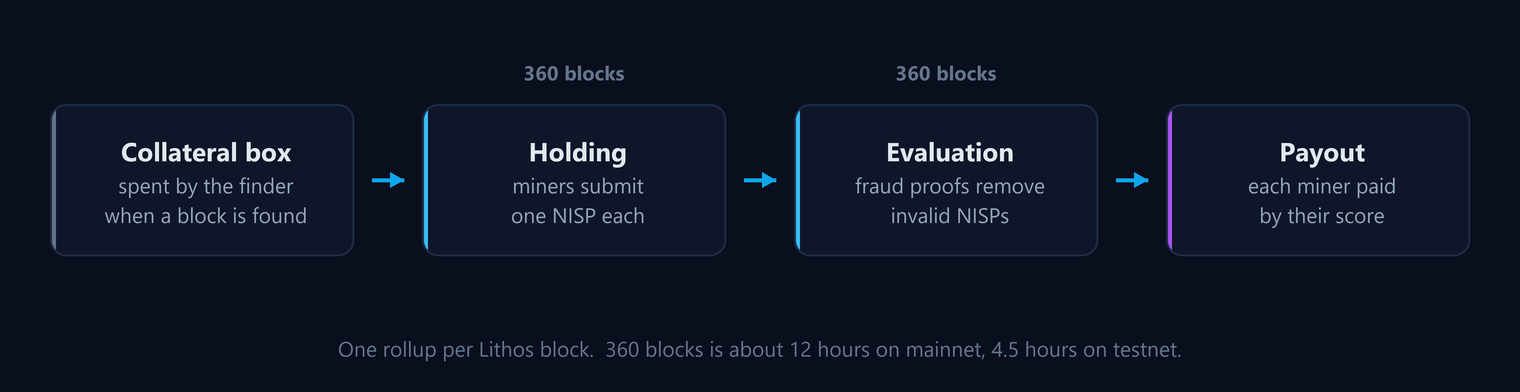
Each phase is 360 blocks: about 4.5 hours on testnet at 45-second blocks, and about 12 hours on mainnet at 2-minute blocks.
What you get paid#
You are paid in two currencies:
- ERG: the pooled block subsidy. Ergo pays a flat 3 ERG per block, of which at least 2.91 ERG is shared among the miners who proved work on that block.
- LIT: the Lithos protocol token. Each Lithos block emits new LIT, and most of it is paid to miners alongside the ERG.
Your share of both is set by your score, not by how many shares you sent. Score is the difficulty value you commit to on-chain in advance, and it is the single number that decides your payout. The startup guide covers how to choose it.
What the genesis transaction pays out#
Everything a Lithos block distributes happens in one transaction, and you can read it on an explorer. The following is a real testnet genesis transaction. The collateral box goes in, and seven outputs come out:
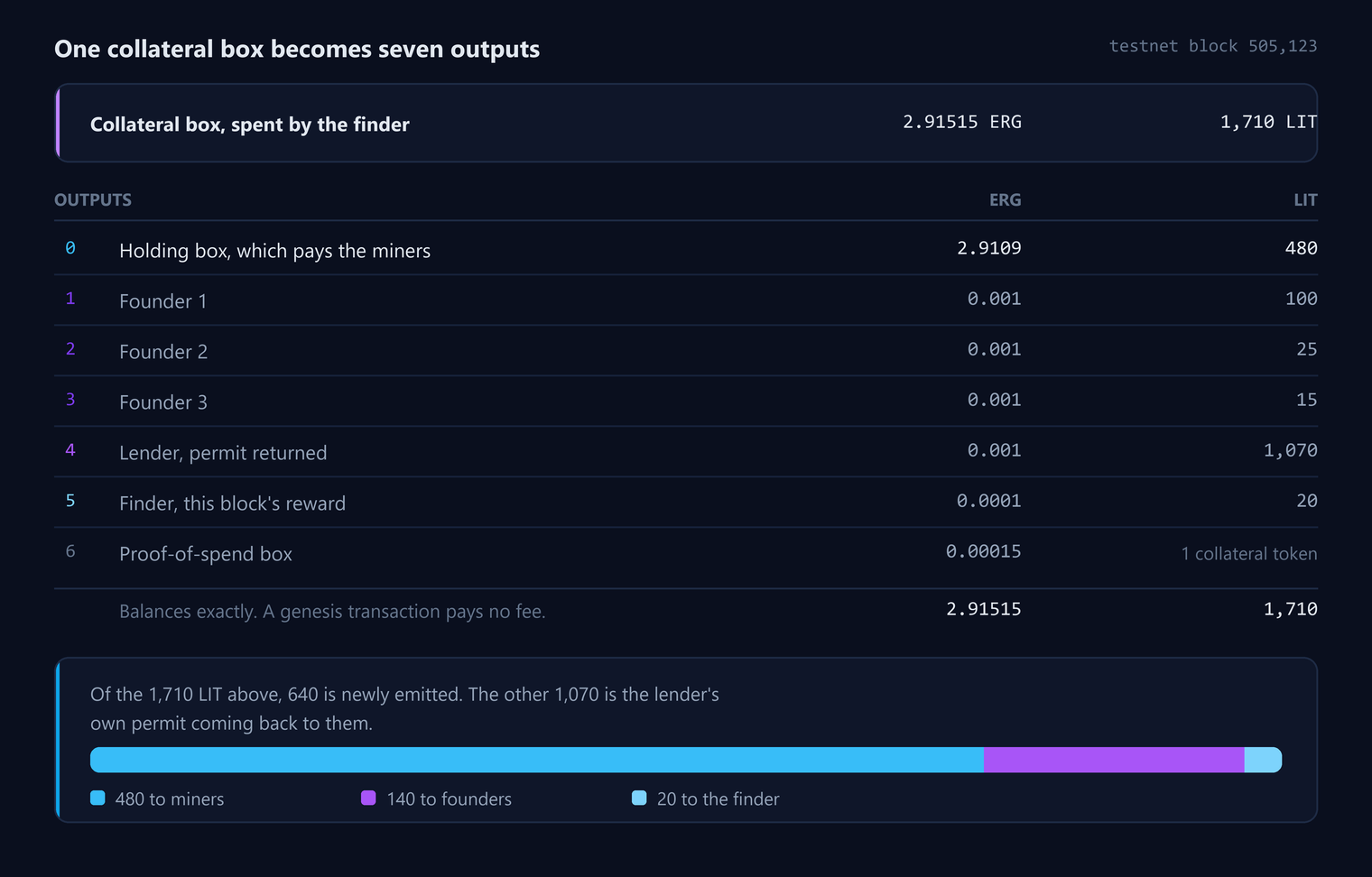
Three things to read out of it:
- The miners' share is output 0. Of the 2.91515 ERG posted, 2.9109 ERG goes to the holding box that later pays miners by score. The rest funds the small boxes the other outputs need.
- The lender's 1,070 LIT is not a reward. It is their own permit being returned, unchanged, now that the box has been used. Only 640 LIT is newly emitted here, and 480 of that goes to miners.
- There is no fee output. The transaction is inserted into the block directly, so it pays no transaction fee at all.
Where the 3% goes#
The fee is not an operator's cut, because there is no operator. It is the gap between what the block subsidy is worth and what the lender had to post to claim it.
The lender posts 2.915 ERG on mainnet and receives the block's coinbase, which is the full 3 ERG subsidy plus every transaction fee in the block. Two consequences worth knowing before you compare Lithos against a pool's advertised fee:
- 3% is a hard ceiling, enforced by contract. The contract refuses any collateral box below the principal floor, so no miner can ever be charged more than 0.09 ERG of a 3 ERG block.
- Transaction fees in a Lithos block go to the lender, not to the miners. Lithos pools the block subsidy and nothing else. Fee futures markets enable transaction fee revenue to flow back to block miners indirectly through the genesis transaction.
Two ways to take part#
You can mine, lend, or do both.
Mining needs a synced Ergo node, the Lithos client, and mining software that supports Ergo's Autolykos 2 algorithm. You commit to a difficulty, mine, and the client submits your NISPs for you. Start with the startup guide.
Lending means placing collateral into the queue so miners can spend it. A position locks 2.915 ERG plus a permit, which is an amount of LIT held alongside the ERG. Both return to you when a miner spends the box, along with that block's coinbase. Neither can be withdrawn before then. The client's web interface handles this; see the collateral pages there.
What you need to run Lithos#
The following are the minimum requirements for mining on the Lithos testnet:
| Requirement | Minimum |
|---|---|
| Java | Java 11 |
| Ergo node | Version 6.0.4 or later, running on testnet, indexed and fully synced |
| Mining software | Any Autolykos 2 miner. SOAT Miner is open source, has no dev fee, and supports Lithos directly |
| GPU memory | About 2 GiB of free VRAM on testnet, growing with the chain height |
The startup guide walks through each of these.
The client's API and web interface#
The Lithos client serves a local HTTP API and a web interface on http://localhost:9000. The interface
shows your mined blocks, payments, stratum state, collateral positions and the LithosDex.
The same API is documented, and callable, from these docs. See Lithos API to read the endpoints and send test requests to your own client.
Next steps#
- Startup guide: install and run the client, from nothing to mining.
- Mining on Lithos: how work is proven and scored.
- LithosDex: trading ERG and LIT, and providing liquidity, from the client.
- LFSM: the contract set that runs the protocol, for readers comfortable with smart contracts.